
Insights
AI Medical Scribes Explained: How They Work and What to Expect
Published:
Jan 21, 2026

Clinical documentation has become one of the most significant sources of friction in modern healthcare. Physicians are expected to produce detailed, structured notes for every patient encounter while managing full schedules, complex cases, and increasing administrative demands.
The result is longer workdays, after-hours charting, and less time spent focused on patients.
AI medical scribes are emerging as a practical response to this problem.
Unlike traditional scribes or generic voice tools, these systems are designed specifically for clinical environments. They listen to patient visits, identify medically relevant information, and generate structured notes that clinicians can review and sign, all with minimal disruption to existing workflows.
This guide explains what an AI medical scribe is, how it works, where it fits in clinical practice, and its limitations.
Whether you’re a clinician exploring documentation support or a healthcare leader evaluating AI tools, this article aims to give you a clear, realistic understanding of how AI medical scribes are being used and where they’re headed next.
Before we get into the nitty-gritty of things, let’s define what an AI medical scribe is.
What Is An AI Medical Scribe?
An AI medical scribe is a tool that helps clinicians document patient visits by automatically generating draft notes from the conversation. Instead of typing during appointments or dictating notes afterward, clinicians can focus on the encounter while the scribe captures and structures the information in the background.
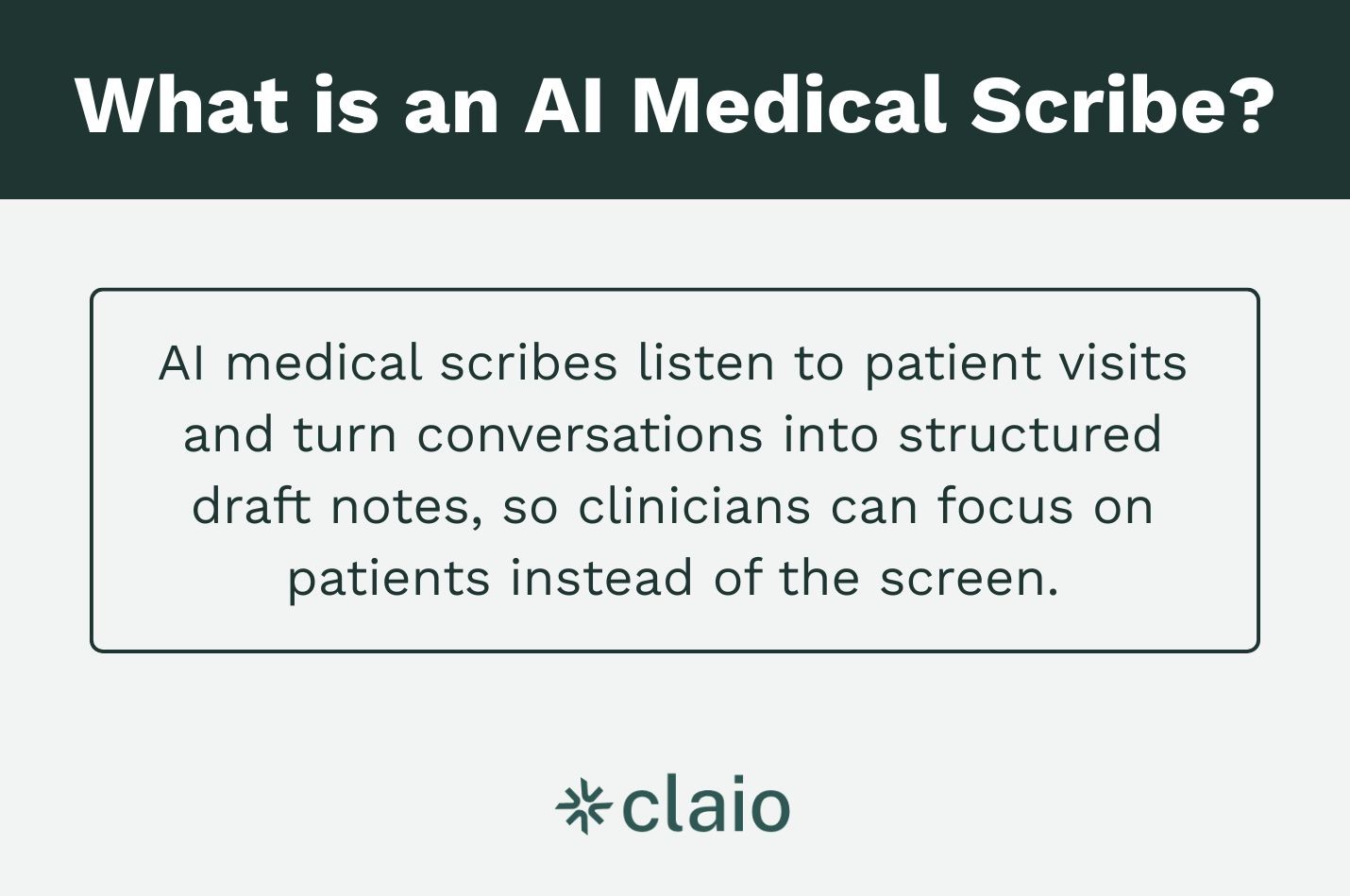
Unlike general voice or AI tools, AI medical scribes are built specifically for healthcare.
They recognize medical terminology, understand clinical context, and organize information into standard formats such as SOAP notes, progress notes, or specialty-specific templates, making drafts easier to review and finalize.
Importantly, AI medical scribes do not replace clinical judgment. Clinicians remain fully responsible for diagnoses, treatment decisions, and the final medical record. The scribe’s role is strictly to reduce the time and effort required for documentation.
The concept itself is simple. What separates AI medical scribes from generic AI tools is how they function during real patient encounters. Here’s how these systems work in practice.
How Do AI Medical Scribes Work?
AI medical scribes generally fall into two categories: ambient scribes and dictation-based scribes. The category they’re in influences how they work.
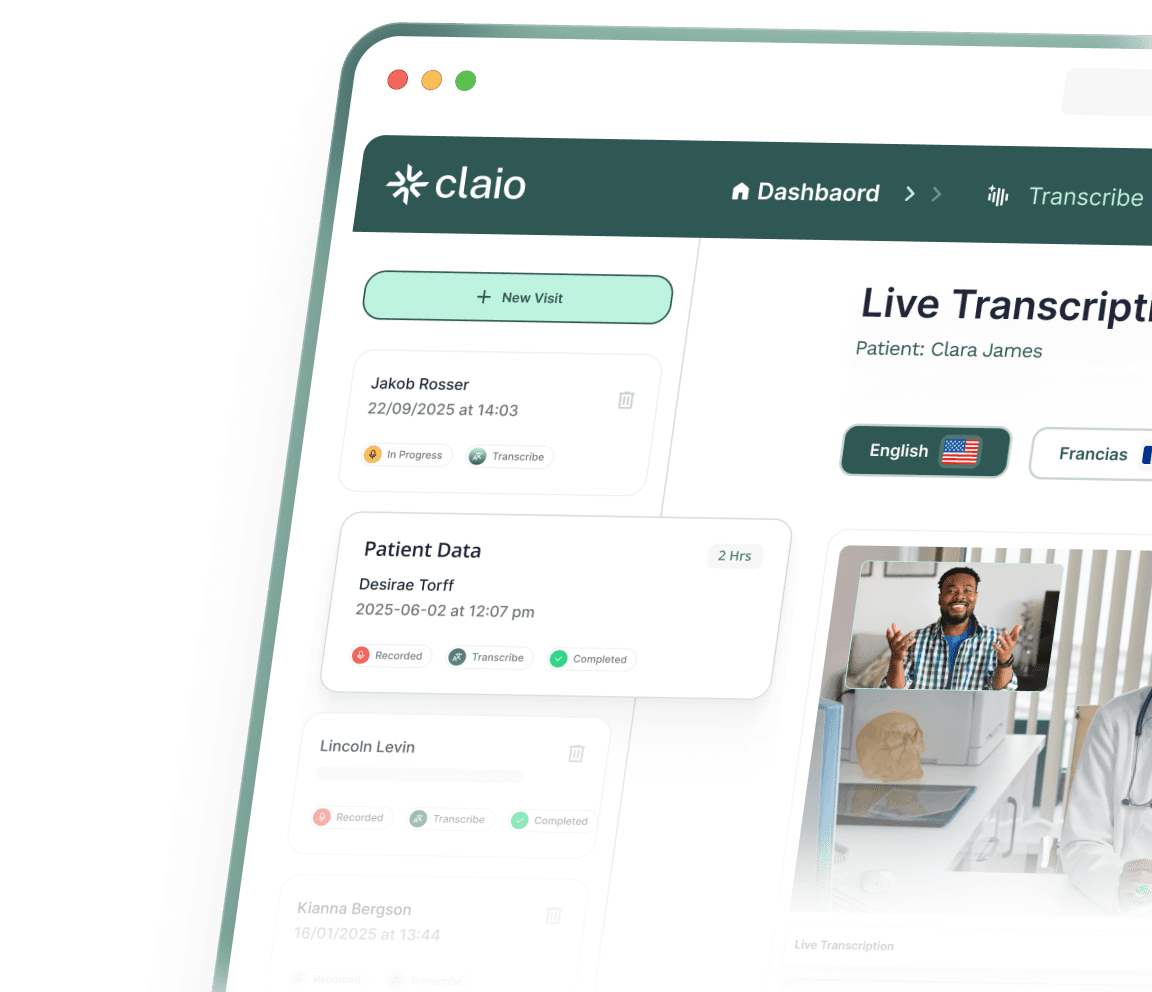
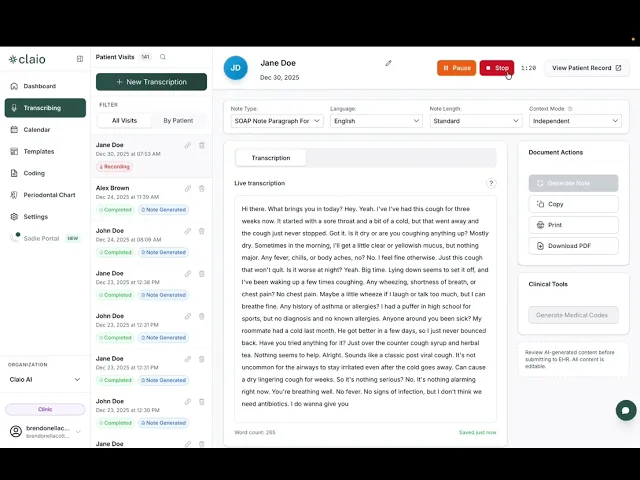
Ambient scribes, such as Claio, listen in the background and capture relevant clinical information as the conversation unfolds naturally, without prompts or commands.
Dictation-based scribes, by contrast, require clinicians to dictate instructions or structured portions of the note actively.
Both approaches aim to reduce documentation time, but the capture method can significantly affect how well the technology fits into the flow of a live clinical encounter.
Below, we walk through how ambient AI medical scribes work in practice.
Step 1: Capturing the Visit
With ambient scribes, listening is activated at the start of a visit through a phone, tablet, or computer microphone.
There are no wake words, commands, or pauses required. The clinician speaks naturally with the patient while the system passively captures the conversation.
This allows the visit to proceed without interruption. Clinicians don’t need to think about documentation while speaking, and patients are not affected by the technology running in the background.
Step 2: Transcribing the Conversation
As the visit unfolds, voice-to-text technology converts spoken dialogue into text.
Remember, unlike general transcription tools, medical scribes are tuned for clinical language, recognizing medical terminology, abbreviations, and common clinical phrasing.
Step 3: Identifying Who Is Speaking
The system separates the clinician from the patient; the technical term for this process is diarization.
This helps the AI distinguish between information reflecting patient-reported symptoms and that reflecting clinical observations, questions, or assessments.
Step 4: Structuring the Clinical Note
Rather than producing a verbatim transcript, the AI extracts clinically relevant information and filters out small talk or non-clinical exchanges.
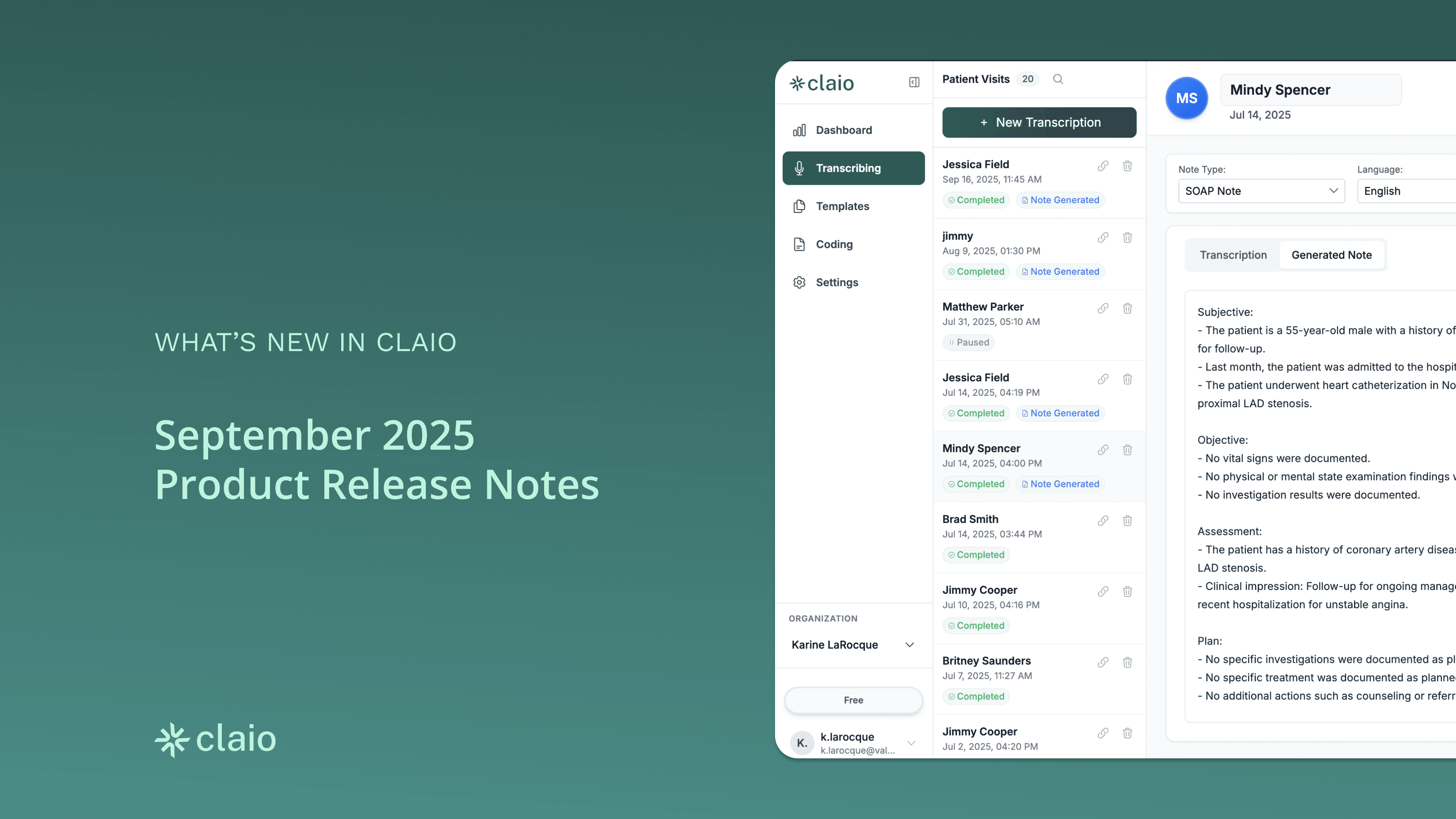
Key details are then organized into familiar documentation formats such as SOAP notes, separating subjective complaints, objective findings, assessments, and plans.
Step 5: Review and Sign-Off
In more advanced setups, the draft note can be sent directly to the electronic health record.
The clinician reviews the note, makes any necessary edits, and signs it before it becomes part of the patient's chart.
The AI assists with documentation, but the clinician remains fully responsible for the final record.
Here is an example of how you can create your first note with Claio.
Benefits of AI Medical Scribes (and Who Can Use Them)
In theory, by looking at how medical AI scribes work, it’s clear that integration into clinical settings can change how medical professionals experience documentation throughout the day.
From a day-to-day perspective, here are some benefits clinicians could see, and are already seeing.
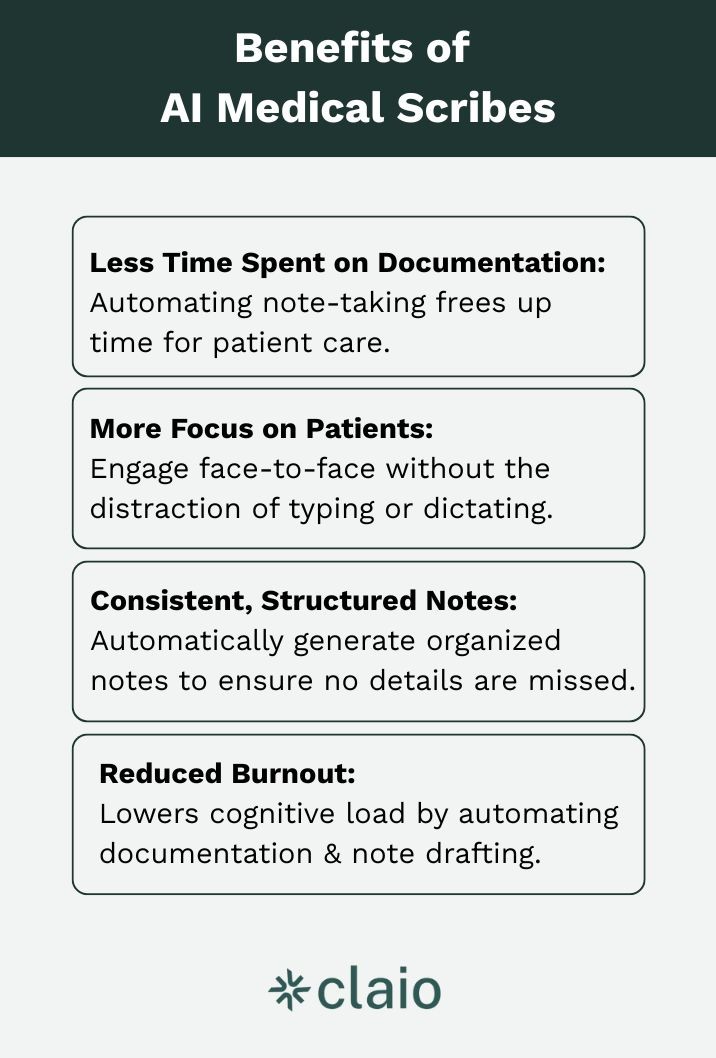
Less time spent on documentation
While the time-saving benefits of AI scribes are intuitive, large-scale data now confirms their impact.
An analysis by The Permanente Medical Group (TPMG), published in NEJM Catalyst, examined the use of ambient AI scribes across millions of patient encounters and found that physicians saved an estimated 15,791 hours of documentation time, equivalent to 1,794 eight-hour workdays that could be redirected toward patient care or personal time.
More focus during patient visits
Without the pressure to type or dictate in real time, clinicians can stay engaged in the conversation.
The same study by TPMG found that patients also reported improved visit experiences, noting that clinicians spent more time engaged face-to-face and less time focused on a computer screen.
Boston-based Dr. Abdulnour says AI scribes enable him to conduct more research, talk to his patients, and that the patients themselves are saying, “my doctor’s looking at me instead of looking at the screen”.
Data and real-world experiences support AI medical scribes offering more natural interactions, better listening, and a stronger patient experience.
Consistent, structured clinical notes
AI medical scribes do more than convert speech to text. They organize information into standardized formats such as SOAP notes. This makes charts easier to review, supports continuity of care, and helps ensure important clinical details aren’t missed.
A separate 2025 systematic review published in the National Library of Medicine found that, in real-world clinical settings, AI scribes reliably produce structured draft notes that clinicians can quickly review and refine, rather than create from scratch.
Reduced cognitive load and burnout
By handling the first draft of documentation, AI medical scribes are able to reduce the mental strain of switching between patient care and charting, which can help lower documentation-related burnout.
In a multicenter study published in the JAMA Network, 263 ambulatory clinicians who used an ambient AI scribe for 30 days showed a 74% lower likelihood of meeting a burnout threshold.
Benefits were observed across multiple ambulatory specialties (primary care, pediatrics, OB‑GYN, adult specialties), supporting the idea that AI scribes are especially helpful where encounters are highly cognitive and documentation‑heavy.
Taken together, these benefits explain why AI medical scribes are gaining traction in clinical settings.
That said, understanding their limitations is just as important when evaluating whether they’re the right fit for a particular workflow.
Risks and Limitations to Be Aware Of
AI medical scribes are designed to assist with documentation, not replace clinical oversight. All notes still require clinician review and sign-off to ensure accuracy, especially in complex or nuanced cases.
Performance can vary depending on factors such as specialty, speaking style, and audio quality. Ambient systems, in particular, rely on clear conversations and suitable environments. Background noise, overlapping speech, or poor microphone placement can affect transcription quality and note structure.
There is also a short adjustment period as clinicians learn how to incorporate an AI scribe into their workflow effectively. As with any clinical software, practices must ensure the tool meets privacy, security, and compliance requirements before adoption.
Many of these limitations can be reduced by choosing the right platform.
For example, Claio has demonstrated over 98% accuracy across clinical conversations, including specialized medical terminology. Its AI improves over time through continued use and customizable templates, and it is built to meet HIPAA compliance standards.
Recent platform updates have focused on reducing manual corrections and improving real-world reliability. These include adaptive word banks that learn from clinician edits, better handling of specialty-specific language, and enhanced coding support such as CPT modifier suggestions and confidence indicators. Together, these workflow improvements help ambient AI scribes perform more consistently across everyday clinical settings.
AI Medical Scribes Are Redefining the Patient-Physician Connection
AI medical scribes are often the first entry point for AI in clinical workflows, but they are rarely the last. AI’s role is already expanding beyond documentation into areas such as medical coding, patient communication, and administrative support, while keeping clinicians firmly in control.
The most effective AI tools in healthcare will be those that prioritize accuracy, transparency, privacy, and clinician oversight.
When implemented thoughtfully, they integrate quietly into care delivery and reduce administrative burden without disrupting how clinicians practice medicine.
For now, the value of AI medical scribes remains simple and tangible.
They give clinicians back time, reduce after-hours charting, and allow patient conversations to take center stage again. AI medical scribes are now a practical tool already reshaping modern clinical practice.

Ready to streamline your documentation?
Join hundreds of healthcare providers who save time with AI-powered clinical notes and increase their productivity.