Perspectivas
How Healthcare Providers Are Using AI Receptionists to Answer Patient Calls More Reliably
Publicado:
21 ene 2026


For most healthcare clinics, the front desk operates under constant pressure. Staff are expected to answer phones, manage schedules, handle paperwork, and support patients standing in front of them, all at once.
As one medical receptionist told a reporter, “When the phone lines open, it just goes manic.”
That moment captures a reality many clinics recognize immediately, and when call handling relies entirely on human availability, something inevitably gives.
Calls are placed on hold, details are rushed, and appointments are missed or misbooked. Over time, these small breakdowns create larger problems: everything from frustrated patients to scheduling inefficiencies to lost bookings that never make it into the system.
For medical clinics, physiotherapy practices, dental offices, therapists, and similar providers, this becomes a barrier to growth.
Healthcare-specific AI receptionists are being adopted as a support layer for this exact problem.
They answer patient calls, guide conversations toward clear outcomes, and help ensure routine requests don’t get lost during busy periods.
Before getting into the details, it’s important to clarify what an AI receptionist is, and just as importantly, what it is not.
What is an AI Receptionist?
An AI receptionist is not a replacement for your clinic's front-desk staff.
It does not diagnose conditions, provide medical advice, or make judgment-based decisions. It also does not override clinic rules, scheduling logic, or provider preferences.
Instead, it’s designed to support the front office. There are many ways AI receptionists can do this, everything from answering phone calls to basic intake and even appointment scheduling.
In this article, we’re specifically going to explore how healthcare AI receptionists handle patient calls in practice and where they fit within existing clinic operations.
How AI Receptionists Handle Patient Calls in Practice
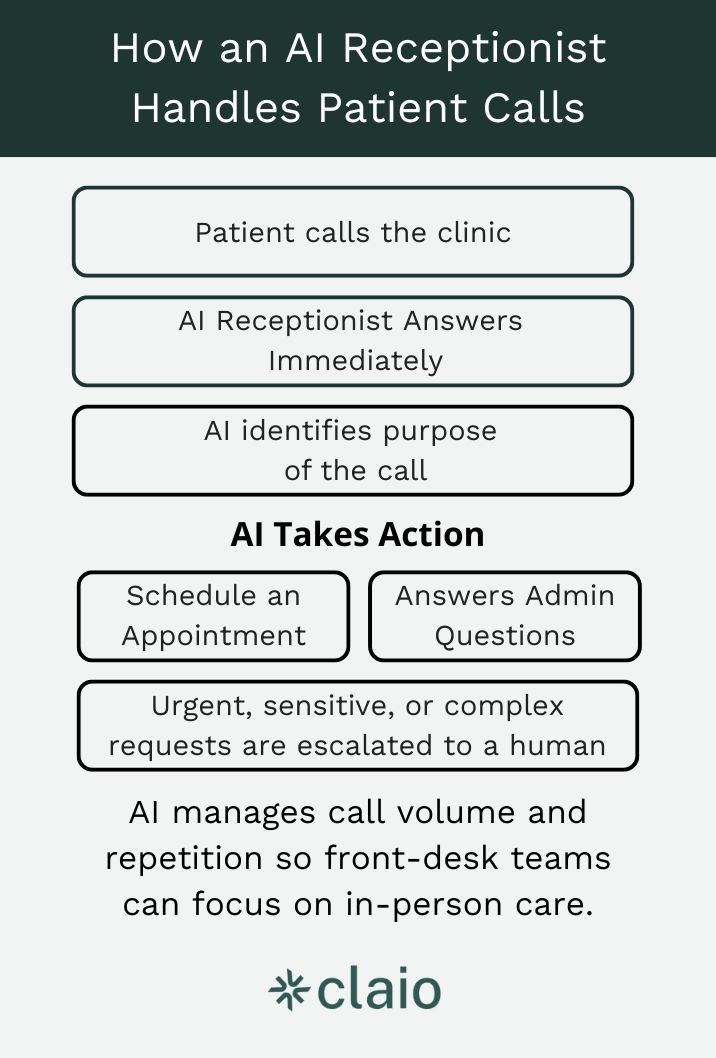
When a patient calls, the AI receptionist answers immediately. There are no phone trees, long hold times, or voicemail prompts.
The conversation begins naturally, allowing the caller to explain why they’re calling in their own words.
From there, the AI identifies the purpose of the call, whether that’s booking an appointment, rescheduling, cancelling, or asking a basic administrative question, and guides the conversation toward the appropriate next step.
When a call falls outside predefined boundaries, such as urgent situations, sensitive concerns, or complex requests, the AI can escalate the call to a human team member with the relevant context already captured.
This ensures patients are supported without being forced to repeat themselves, while staff retain control over decisions that require clinical or situational judgment.
In practice, an AI receptionist acts as a support layer for call handling.
It manages call volume and repetition so front-desk teams can focus on in-person patients, exceptions, and interactions that genuinely require a human touch.
Why Clinics Are Adopting AI to Answer Calls
Now that you’ve seen how AI receptionists handle calls in practice, it’s easier to see the operational challenges they’re designed to solve.
1. AI Reduces Missed Calls With Always-On Answering
Traditional call handling depends on staff availability.
When front-desk teams are busy with in-person patients, paperwork, or insurance questions, calls are placed on hold or sent to voicemail.
Many patients don’t wait, and follow-ups only happen if time allows.
AI receptionists eliminate this dependency by answering calls immediately, even during peak hours, lunch breaks, and other busy periods.
Patients can explain why they’re calling right away and move toward a clear next step, rather than being told someone will call them back.
2. Reduces Front-Desk Workload From Incoming Calls
In a traditional setup, every phone call interrupts front-desk work. Staff are constantly switching between the waiting room and the phone, which increases fatigue and the risk of errors.
AI receptionists handle routine call volume in the background, allowing staff to focus on in-person patients and administrative tasks without constant interruption. This reduces burnout while keeping the front desk responsive.
3. Standardizes Call Handling and Information Capture
Manual call handling often relies on memory, handwritten notes, or rushed data entry.
The quality of the call experience can vary depending on who answers and how busy the clinic is at the time.
AI receptionists provide a consistent call experience.
The same core details are captured every time and uploaded to your patient management system, regardless of call volume or time of day.
4. Extends Call Coverage Beyond Business Hours
In traditional systems, calls outside business hours are usually unanswered or routed to voicemail.
Patients may never hear back, especially if the message isn’t urgent enough to trigger a callback.
AI receptionists enable clinics to answer after-hours calls, capture requests, and flag urgent issues when needed, without requiring overnight or extended staffing.
5. Supports Clinic Growth
As call volume increases, traditional call handling scales by adding staff. This can be costly, difficult to sustain, and slow to implement.
AI receptionists give clinics a way to handle more patient calls with the team they already have, while maintaining control over escalation and decision-making.
Most importantly, AI receptionists don’t replace human judgment.
They handle volume and repetition, while staff step in when a call requires clinical insight, discretion, or a human touch.
How to Choose an AI Receptionist That Handles Calls for Your Clinic
Not all AI receptionists are built for healthcare, and not all can safely handle patient calls.
Choosing the right solution means finding a system that supports real clinic workflows without introducing additional risk or operational complexity.
If you’re evaluating options, these are the features that matter most.
1. Built for Healthcare Call Handling
Healthcare calls aren’t generic customer service inquiries. A system that doesn’t understand the difference between a routine follow-up and a potentially urgent concern will create more problems than it solves.
Look for an AI tool with a built-in reception feature that’s specifically designed for healthcare environments, with clear boundaries around what it can and cannot do.
It should respect clinical context, recognize sensitive situations, and avoid providing medical advice or diagnoses.
Book a demo of Claio's AI Receptionist
2. Answers Calls and Moves Them Forward
Some tools are essentially voicemail replacements that transcribe messages and leave the sorting to staff later.
Others are designed to actively guide calls toward resolution.
A healthcare AI receptionist should answer calls immediately and help patients book, reschedule, or cancel, or obtain basic administrative information, without creating additional follow-up work for the front desk.
3. Clear Escalation to Human Staff
An effective AI receptionist knows where its role ends.
It should be able to recognize when a call requires human judgment and transfer it smoothly, without friction for the patient.
That handoff should include full context, so staff don’t need to ask patients to repeat themselves or start the conversation from scratch.
4. Works With the Systems You Already Use
AI receptionists should support existing clinic systems and not force a technology overhaul.
Solutions that require replacing phone providers or reworking core software introduce unnecessary risk and training overhead.
Look for tools that sync with your scheduling or patient management system. Rather than simply take a message, the AI should be able to log conversations directly into the patient record or CRM, ensuring your staff always has the most up-to-date context without manual data entry.
5. Visibility and Oversight for Your Team
Front-desk staff and clinic managers should never feel disconnected from what the AI is doing.
Transparency builds trust and ensures the system aligns with your standards of care.
Access to call summaries, transcripts, and a central dashboard allows teams to review interactions, follow up when needed, and maintain accountability.
6. Flexibility as Your Clinic Grows
Call volume changes over time.
Clinics add providers, expand locations, and experience seasonal spikes. The system you choose should scale with those changes without becoming harder to manage or more expensive to maintain.
Look for configurable rules, support for multi-provider or multi-location practices, and a pricing model that grows with your clinic rather than penalizing increased usage.
With the right AI solution in place, clinics can handle more calls reliably, without expanding headcount or sacrificing the quality of patient interactions.
Whether those calls come in during clinic hours or after, that foundation makes it much easier to grow with confidence.”
Restoring Balance to the Front Desk
The "balancing act" at the front desk doesn’t have to be a zero-sum game where the phone line competes with the person standing in front of you. By implementing an AI receptionist, clinics can move away from the reactive cycle of missed calls and rushed intake, and toward a proactive, reliable model of patient engagement.
Rather than replacing the human element of healthcare, AI supports and protects it.
By automating the repetitive administrative volume that leads to burnout, AI allows your front-desk team to return to what they do best, providing a warm, focused, and high-touch experience for every patient who walks through your doors.
Ready to see how AI can support your clinic?
If you’re ready to eliminate missed calls and give your front-desk team the breathing room they deserve, it’s time to see an AI receptionist in action.

¿Listo para simplificar tu documentación?
Únete a cientos de proveedores de atención médica que ahorran tiempo con notas clínicas impulsadas por IA y aumentan su productividad.